WHO Collaborative Centre for Cross-Border Public Health
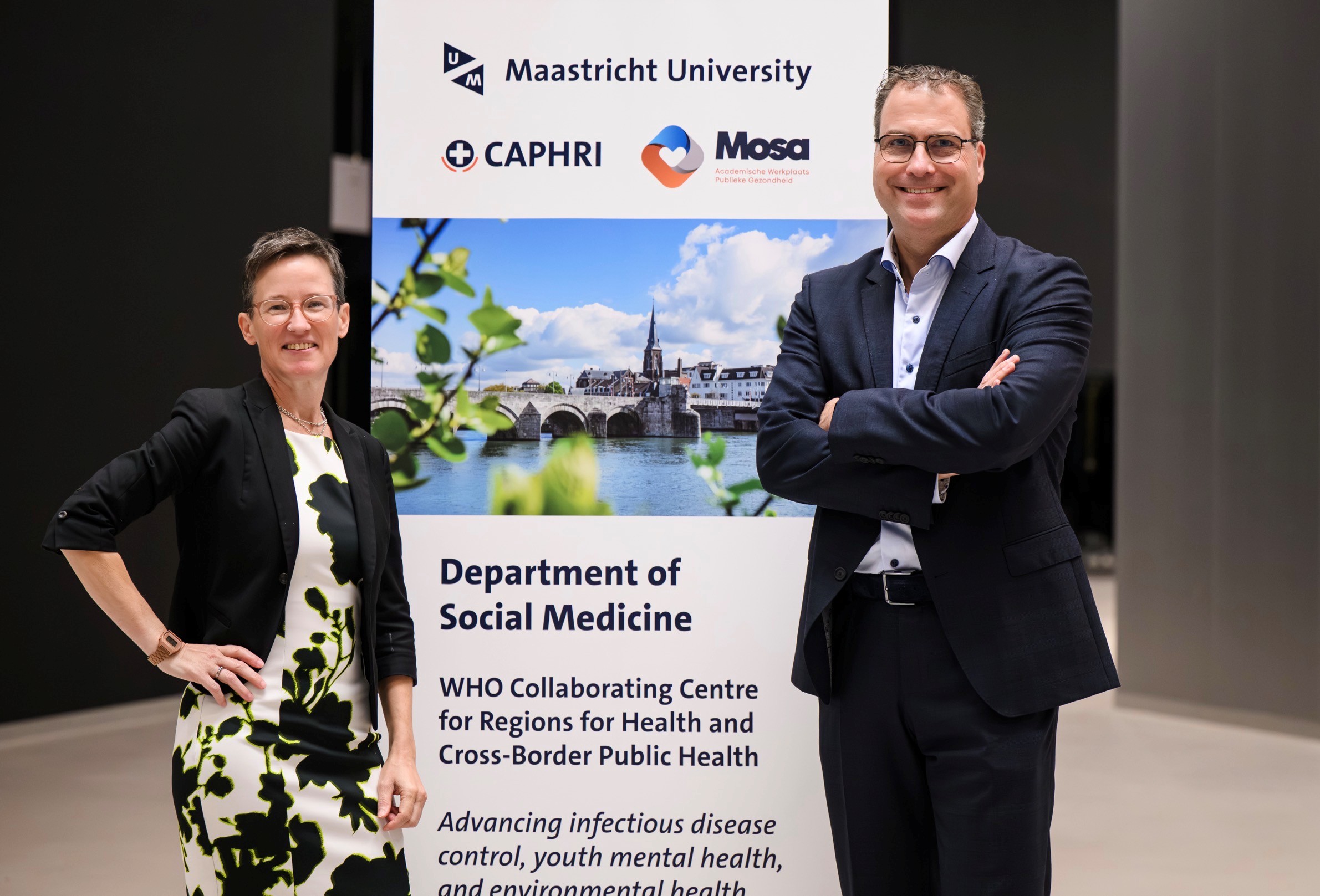
On October 10, 2025, the Care and Public Health Research Institute (CAPRHI) of Maastricht University launches two Collaborating Centres at a hybrid conference, among these our WHO Collaborating Centre Regions for Health and Cross-Border Public Health led by the Department of Social Medicine.
We are proud to announce that as of March 13, 2025, CAPHRI, Maastricht University has been officially designated as one of the first two WHO Collaborative Centres at our institution! The new centre, WHO CC Regions for Health & Cross-Border Public Health, has received approval for a four-year term. This WHO CC will focus on three vital public health themes: Infectious disease control, Youth mental health and Environmental health and is part of Living Lab Public Health Mosa. Led by Prof. Dr. Christian Hoebe (Chair of the Department of Social Medicine and Living Lab Public Health Mosa) and Dr. Rianne Reijs (Youth Health Physician), the centre will bring substantial value to Maastricht University, CAPHRI, our WHO partners—and most importantly, to the citizens of Europe, especially those living in the Euregion Meuse-Rhine.
Special thanks to PhD candidate Brigitte van der Zanden, whose dedication was instrumental in the realization of this WHO CC; as former director of EUprevent, she brought invaluable expertise, vision, and cross-border experience to the table. “It’s an honour and a privilege to receive this recognition from the WHO—both at global and European level,” says Prof. Hoebe. “The WHO Regions for Health Network has long acknowledged the importance of cross-border research and public health practice.
Our centre continues this tradition, built on 20 years of dedicated work in the field.” The centre aligns closely with the strategic vision of the Maastricht University–Maastricht UMC+ alliance. It also addresses a pressing reality: around 30% of the EU consists of border regions, home to roughly 125 million people who often rely on cross-border access to healthcare, work, education, and daily life needs. These regions face unique challenges—differences in laws, healthcare systems, and socioeconomic conditions—but also offer exceptional opportunities for collaboration.